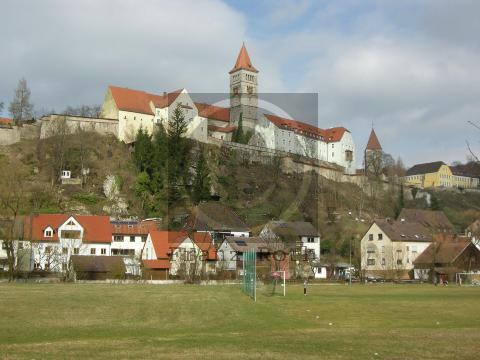
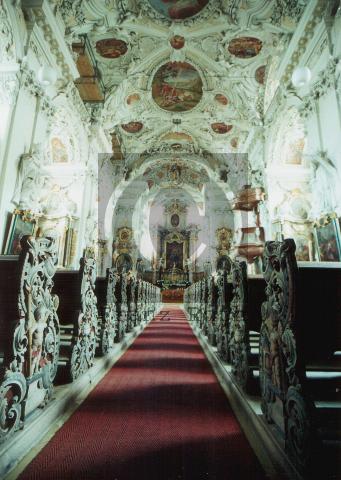
 The most important church of the South German Baroque
 The Church of Premonstratensian Speinshart in the Upper Palatinate (administrative district Neustadt am Kulm) is probably the most important religious work of South German Baroque. The rich Stukkaturenschmuck Carlo Domenico Lucese is not how other local stucco executed in plaster, but of sand and Lime shaped and covered with lime been. Another special decoration of the church are the original pews and ornate cheeks of that work fine in muted colors with the color design of the main vessel.
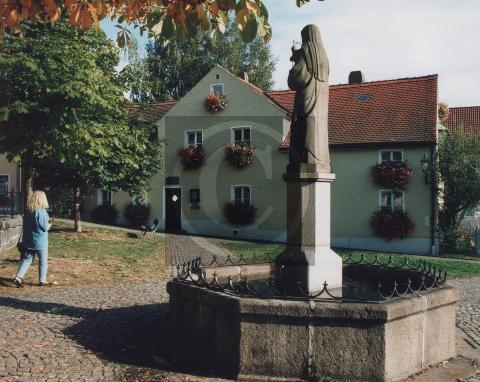 birthplace Theresa Neumann, Konnersreuth
 The stigmatized by Konnersreuth - The controversial beatification of Therese Neumann - Even the birth of Schneider's daughter Therese Neumann Konnersreuth in the Upper Palatinate (administrative district Tirschenreut) is surrounded by myths: it is to 1898 have been born on a Good Friday. As a servant at a farmer she crashed heavily during a fire and will, blind and paralyzed, have been tied seven years 1918-1925 to the bed. As a child she had been a great admirer of her namesake Norman, Therese of Lisieux. The prayer had been heard about this Therese, Neumann said later, and the miracle of recovery is to explain exactly to the anniversary of the canonization of Therese of Lisieux have happened. And, not all of the miracles occurred soon after the Good Fridays on with her bleeding wounds on the hands and feet. For the first time on the night of Good Friday in 1926. In addition to this until her death in 1962 repeating stigma also witnessed repeatedly in the ecstatic visions of scenes from the Bible and de saints. The crowd of their supporters and admirers who believe in the miraculous power of Therese Neumann is legion. After more than 40,000 petitions from all over the world, the Bishop of Regensburg Gerhard Ludwig Müller, after years of preparation has now launched the beatification proceedings. What has caused a renewed violent flare-up of the dispute about the miraculous power of "Tessa," as she is popularly called.
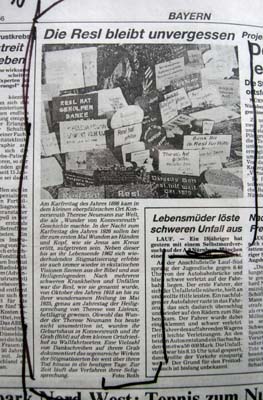 While it has long been a saint for her admirers, she is for the critics of the cult around her, on more liberal side of the Catholic Church, more of a research case for psychologists and psychiatrists in the community Konnersreuth one is a expansion of the cult of Tessa well prepared. As of May then the birthplace of Therese Neumann, in which a fountain with a statue of Therese of Lisieux, every day is open to interested visitors. For some 50,000 visitors of the 2,000-strong village is one year. Rising.
 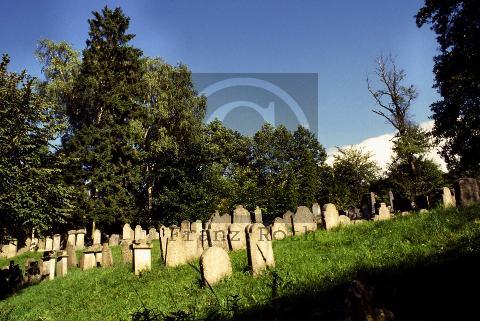 Jewish cemetery in Floss, Oberpfalz
 raft is a market in the Upper Palatinate district of Neustadt an der Waldnaab and can look back on more than 1000 years of history. Jewish cemetery in use since at least 1692 (undecipherable oldest grave stone). Although the camp was Flossenbürg in the area, this cemetery was strangely not as so many others in the time of the Nazis desecrated. As the term "house of eternity" indicates, a Jewish grave for eternity is for. He will not be leveled and made the stone remains. For lack of space you put a layer of earth over a grave and buried the dead on the other. This is related to the Jewish faith together in the resurrection of the dead. Since the dead are not to be contaminated with fermenting, acidifying or other by-products of decomposition, to be dispensed with flowers, instead, small stones placed on the grave stones. The graves can be with ivy and grass. After visiting the cemetery washed his hands, because the proximity of the dead ritually unclean. On Shabbat, one does not go to a cemetery. Because in death all people are equal, can be found until the mid-18th Century uniform grave stones.